
Moving in summer in Valencia: tips for a move in the heat
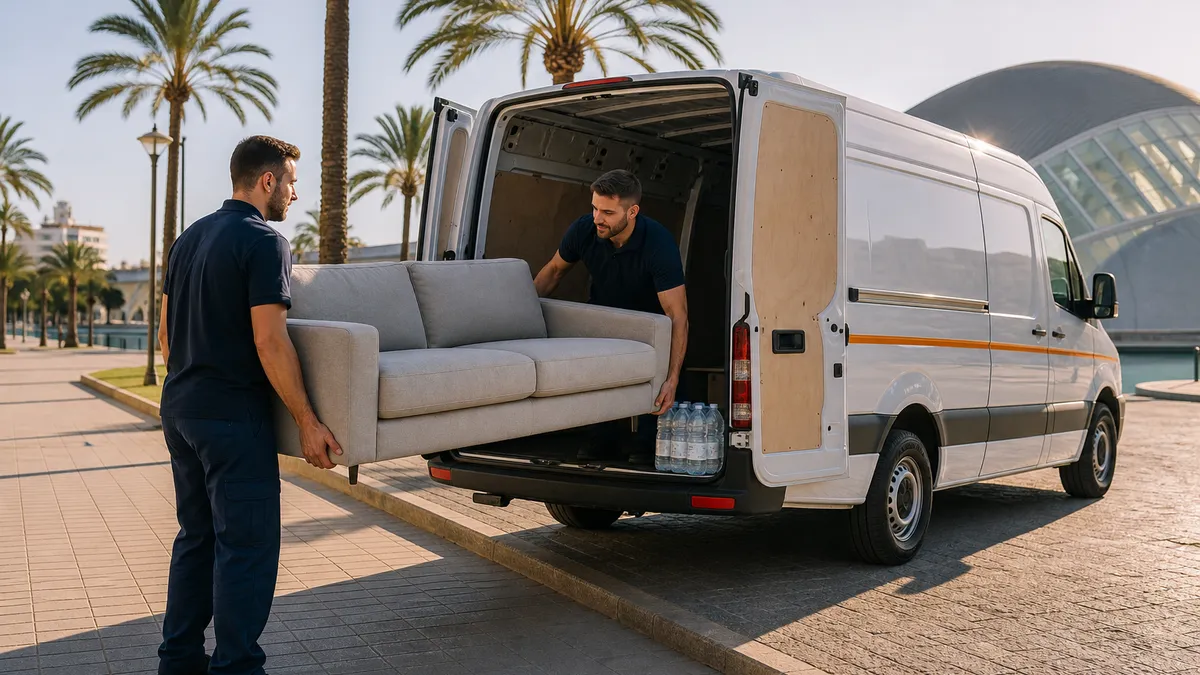
A summer move in Valencia goes smoothly if you start at 7–8am and have the heavy items loaded before 1pm. From May to October daytime highs sit around 30–33 °C with high humidity, and a closed van in the sun passes 50 °C — no place for candles, medicines, vinyl or batteries. The approximate price is the same as the rest of the year — van with driver €55/h, two-hour minimum (€110), mover €20/h — but the heat stretches the hours if the move is badly planned.
This guide covers what actually changes when you move in the hot season: timing, water and breaks for the crew, what to protect, how long to wait before plugging in the fridge and air conditioning, the August peak and parking. If you are still working out a budget, start with how much a move in Valencia costs.
Why heat makes a move more expensive (even though the rate doesn’t change)
Moves are paid by the hour, and heat is the biggest time thief of the year. A crew loading at 26 °C at 8am works at a steady pace; the same crew at 34 °C in an airless stairwell at 4pm needs more breaks, carries less per trip and takes longer. For a two-bedroom flat (approximately 4–6 hours, €300–450), the difference between a morning move and an afternoon one can easily be an hour: €65 with a van and one mover (the driver).
| Time slot (May–October) | Typical temperature | Work pace | Recommendation |
|---|---|---|---|
| 7:00–10:00 | 23–27 °C | Normal | Best window: load the heavy items now |
| 10:00–13:00 | 27–31 °C | Slightly slower | Finish loading and head off |
| 13:00–17:00 | 31–34 °C, direct sun | Slow, more breaks | Avoid for loading; unloading only if needed |
| 17:00–20:00 | 28–31 °C | Picks up again | Fine for small moves |
These are approximate figures for the city of Valencia; in July and August, when the hot westerly poniente blows, highs can top 38 °C. Check the AEMET weather warnings the day before: under an orange or red heat warning, Spanish labour rules require outdoor work to be adapted or reduced, and the crew may suggest a different time.
How to organise a summer move, step by step
- Book early. From mid-July to mid-September, and on the last day of any month, demand shoots up. Ask for a quote 2–3 weeks ahead so you get the morning slot rather than whatever is left at 3pm.
- Ask for the earliest start. Say in your request that you want to start at 7 or 8am. The crew will confirm whether that works and the price before the job starts.
- Have everything packed the night before. In the heat, packing while the crew waits is doubly expensive. Follow the plan in our guide to moving boxes and how to pack and tape every box shut: cardboard softens in humidity and open boxes lose their shape.
- Defrost and empty the fridge 12–24 hours before. Dry the inside and leave the door ajar so it doesn’t smell. Eat or give away anything perishable: no cool box survives a full August morning.
- Get water and shade ready. A cool box of cold bottles by the door, persianas (shutters) down in both homes and a fan on the landing if you have one.
- Set aside anything heat-sensitive. One box or bag travels with you, in an air-conditioned car, never in the van (see the table below).
- At the new place, bring the heavy items in first, while it is still cool. If there is no lift at the destination, add one more mover: carrying furniture up to a fourth floor at midday is where the heat really bites.
Water and breaks: look after the crew (and yourself)
Carrying furniture at 30 °C and 70% humidity is hard physical work. A sensible baseline is 2 litres of water per person for a morning, short breaks in the shade every hour and cold drinks at the new home. It is not just good manners: a hydrated crew works faster and makes fewer mistakes with fragile items.
If you want loading to go genuinely quickly in the heat, book one more mover than you would in winter: two people take turns on the heavy pieces and rest without the job stopping. An extra mover on a van job is approximately €20/h per person; see loaders in Valencia.
What heat damages and how to transport it
The cargo area of a van parked in the sun gets far hotter than the air outside. These are the things that suffer most:
| Item | What heat does to it | How to move it |
|---|---|---|
| Medicines | Many must be kept below 25–30 °C; insulin and some eye drops, refrigerated | With you, in a cool bag if needed |
| Candles and wax | Warp or melt | In a small box in the shade, or with you |
| Vinyl records | Warp from around 50 °C | Upright, packed tight, away from the van walls; ideally with you |
| Laptops, phones, batteries, power banks | Lithium batteries degrade and can swell | With you, switched off or asleep |
| Photographs, documents | Stick together in heat and humidity | In closed folders, in your bag |
| Aerosols and cleaning products | Risk of excess pressure | Keep to a minimum; don’t pack with clothes |
| Wine, chocolate, cosmetics | Spoil or melt | With you, or use them up beforehand |
| Plants | Dry out within hours | Water the day before, keep in shade, load last |
For artwork, antiques or pieces that tolerate neither knocks nor sudden temperature changes, standard packing is not enough — ask for specialist transport with made-to-measure packing. And a tip for electronics: bringing them from a hot van into an air-conditioned flat causes condensation, so wait an hour before switching on screens and computers.
Fridge and air conditioning: how long to wait before switching on
Fridge. If it travelled upright, 2–4 hours is usually enough; if it travelled lying down, wait at least as long as it was on its side and, to be safe, up to 24 hours. The compressor oil needs to settle. The manufacturer’s manual beats any general rule. At 30 °C it will also take several hours longer to cool, so don’t fill it on the same day.
Portable air conditioner. Same logic as the fridge: keep it upright in transit and let it stand for a few hours before switching on.
Wall-mounted split unit. Removing and refitting one involves handling refrigerant gas, and that is a job for a certified installer, not the removals crew. Book the technician early: in July and August air-conditioning engineers fill up faster than movers do.
The August peak and the end of the month
In Valencia several things coincide in summer: rental contracts ending (many run until 31 July or 31 August), students arriving for September and holidays across many trades. So the end of July, most of August and the 28th–31st of any month fill up first. If you can choose, a Tuesday or Wednesday mid-month at 8am is the easiest slot to get.
If the date you hand back your keys and the date you move in don’t line up — very common in summer — consider storing your furniture for a few weeks: our guide to storage units in Valencia when moving sets out the options. And so nothing else slips through the cracks, the moving checklist of what to do before you move works just as well in summer as in winter.
Parking: reserving space on the street
In the heat, every metre between the van and the front door feels twice as long. According to Valencia City Council’s e-office (sede.valencia.es), there are two related procedures:
- Zonas de reserva para carga y descarga en la vía pública para trabajos puntuales — reserving loading and unloading space for one-off works, which includes removals with vehicles under 3,500 kg. You apply one month in advance and a municipal fee for reserving public road space applies.
- Autorización para la realización de mudanzas — a removals authorisation for vehicles of 3,500 kg or more, or when an external lift or pulley is used. Minimum notice is 15 working days (30 on pedestrian streets), with third-party liability insurance and a site sketch.
Requirements, deadlines and fees can change, so always double-check them on sede.valencia.es or with your district’s Junta Municipal. In practice, many smaller moves are handled using nearby loading bays and good coordination. Mention your street when you request a quote for your apartment move, and we will tell you what makes sense.
In short: moving in the heat
Start early, book ahead, pack before the crew arrives, carry heat-sensitive items yourself and don’t switch the fridge on straight away. Send us photos of the rooms, the floor and your date on WhatsApp or through the form on the website: we help you estimate the hours and we confirm the price before the job starts.