
How much can a van carry: tiles, cement bags, plasterboard and pallets
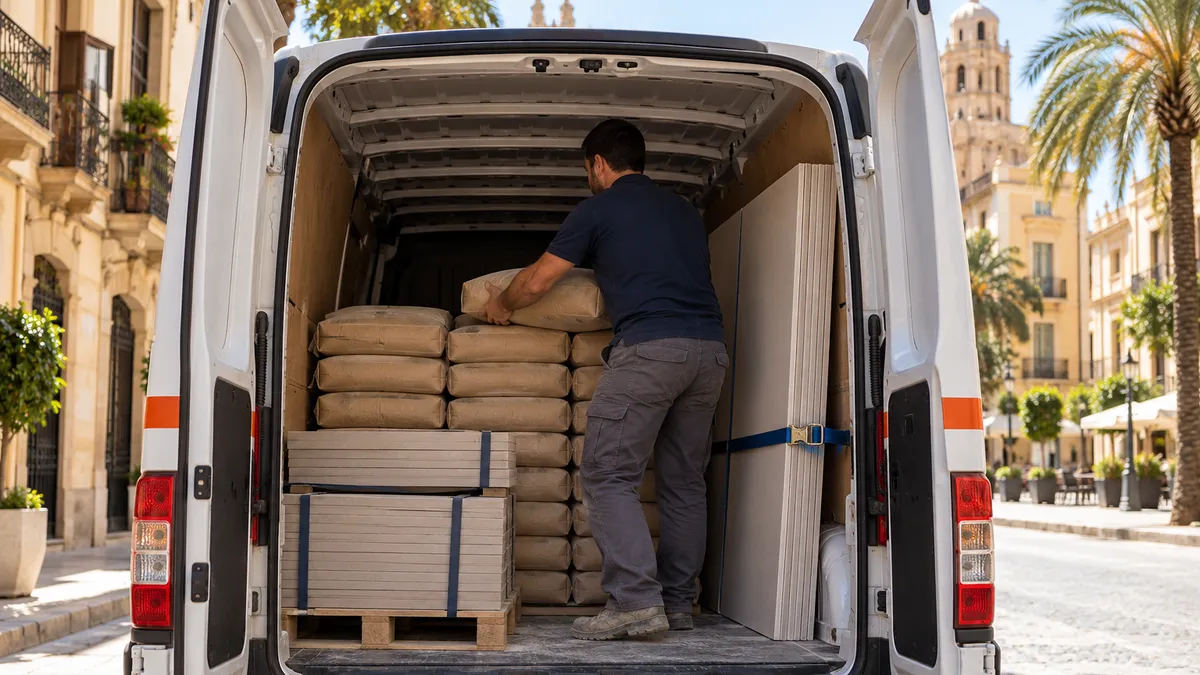
A large 3,500 kg van usually carries between 1,000 and 1,400 kg, depending on the model, not 3,500 kg, because that figure includes the weight of the vehicle itself. With building materials you hit the weight limit before you run out of space: 1,000 kg is about 40 bags of 25 kg, about 50 m² of porcelain tiles or about 40 standard plasterboard sheets.
Below you’ll find how to work out a van’s payload, a table with real weights of tiles, bags, plasterboard and pallets, what happens with long sheets and lifts, and what transport costs in Valencia.
How much can a 3,500 kg van carry?
It can carry its payload: the maximum authorised mass (MAM) minus the mass in running order, both shown on the vehicle’s spec sheet. On large professional vans (Mercedes Sprinter, Ford Transit, Renault Master, Volkswagen Crafter and similar) that difference is usually between 1,000 and 1,400 kg, and it varies with length, roof height, engine and equipment.
A worked example: according to its spec sheet, a 3.5 t medium-wheelbase, high-roof Sprinter (L2H2) weighs about 2,200 kg empty. Take that from 3,500 kg and you’re left with about 1,300 kg for the load.
Three things people forget:
- Passengers count too. Everyone travelling besides the driver, plus tools, straps and pallets, eats into the payload.
- Box vans carry less weight. A box van has more volume (up to about 20 m³), but the box is heavy, so its payload is usually lower than a panel van’s. Ideal for furniture; not necessarily for bags of cement.
- Volume is misleading with building materials. 1,000 kg of bags takes up less than 1 m³ of floor. The van looks half empty when it’s already at its limit.
Driving above the MAM is an offence and also worsens braking and handling. That’s why we always ask about weight before loading. Licence categories are set by Spain’s traffic authority, the DGT: a B licence covers up to 3,500 kg MAM; above that and up to 7,500 kg you need C1 (checked in October 2026). If you’re not sure whether a van is enough, see moving van or truck?.
How much do common building materials weigh?
The exact weight is printed on the bag, on the box label or on the product’s spec sheet: always use it if you have it. As a reference:
| Material | Weight per unit | Units in ~1,000 kg | Source / note |
|---|---|---|---|
| Bag of cement, mortar or tile adhesive | 25 kg (the most common size) | ~40 bags | Weight printed on the bag; other sizes exist |
| Box of 60×60 porcelain tiles (1.44 m²) | ~28 kg (≈ 19–20 kg/m²) | ~35 boxes (~50 m²) | Manufacturers’ spec sheets; varies with thickness |
| Standard 12.5 mm plasterboard, 2.5 × 1.2 m | ~26 kg (8.7 kg/m² × 3 m²) | ~38–40 sheets | Pladur N spec sheet |
| Acoustic or high-impact plasterboard | Heavier: ~12 kg/m², ~37 kg per 3 m² sheet | ~27 sheets | Depends on board type |
| Empty Euro pallet (1,200 × 800 mm) | ~20–25 kg | — | Varies with wood moisture |
To do the maths: add up the weight of everything and compare it with 1,000 kg. If you’re close to it or over, say so when asking for a price: the crew may suggest two trips or a vehicle with a higher payload.
How much do tiles weigh?
Porcelain stoneware weighs roughly 19–20 kg per m² in a 60×60 format around 9 mm thick, according to manufacturers’ spec sheets. A 1.44 m² box comes to about 28 kg. Thin wall ceramics weigh less, and thick or large-format porcelain weighs more; the exact figure is on the box label.
With those figures, a bathroom renovation with 15–20 m² of tiles is about 300–400 kg: it fits comfortably in a van. A floor of 60–70 m² of porcelain goes over a tonne and may need two trips.
How many plasterboard sheets fit in a van?
Space-wise, lots: a standard 2.5 × 1.2 m sheet fits flat in a large van because, for example, a Sprinter L2H2 has about 3.27 m of usable length and 1.35 m between the wheel arches. The real limit is weight: at about 26 kg per standard sheet, 38–40 sheets already add up to a tonne.
What usually gets complicated isn’t the van, it’s the building:
- The lift. In most residential buildings a 2.5 m sheet won’t fit in the lift car. Sheets go up the stairs, two people per sheet, even when there’s a lift.
- The staircase. Tight turns mean carrying the sheet almost upright. It needs room and care with the walls.
- A real case. A customer needed 12 plasterboard sheets taken up to a fifth floor by the stairs: the building had a lift, but the sheets didn’t fit. That’s about 310 kg of board, one sheet at a time, five floors. We cover it in detail in getting Leroy Merlin or Obramat purchases home.
That’s why plasterboard jobs to upper floors normally need two movers. We work out the carry-up in the quote, and you see it before confirming. To understand how floors are priced, read moving without a lift: cost per floor.
Can a van carry a pallet?
Yes. A 1,200 × 800 mm Euro pallet goes through the rear doors of a large van, and the shop or builders’ merchant usually loads it with a forklift. Two things to know, though:
- A full pallet can weigh as much as the whole payload. 40 bags of 25 kg on a pallet are already over a tonne. Ask the shop for the total pallet weight before booking.
- There’s no forklift at the other end. Unloading is normally by hand, bag by bag or box by box. If the material goes to a flat, carrying time counts, and with lots of bags it’s worth booking movers.
If you only need the material dropped at street level and you have help, a van with driver is enough. If it’s going to an upper floor, add movers.
What does it cost to move building materials by van in Valencia?
Transport is paid by the hour: van with driver, approximately €55 per hour, 2-hour minimum (€110), plus €20 per hour for each mover. With a lift, carrying up to the floor is included; without a lift, the crew takes the floor, the stairs and the weight into account in the quote, with no extra charges on the day.
| Typical job | Crew | Approximate price (2 h) |
|---|---|---|
| Collect bags or tiles and drop them at street level | Van with driver | €110 |
| Materials to a flat with a large lift | Van + 1 mover (the driver) | €130 |
| Plasterboard or lots of bags to a flat without a lift | Van + 2 movers (one is the driver) | €170, with the floor and stairs in the quote |
If the job takes longer, you pay the actual hours. You pay after the job is done, in cash or by bank transfer, and the VAT invoice is issued by the partner carrier that does the job. This is a job professionals do every day. All the details are on building materials delivery, and if you need to clear rubble from a renovation, see rubble removal in Valencia.
How to prepare the job so it fits in one trip
- Make a list with weights: number of bags, m² of tiles, number and type of sheets, pallets.
- Ask the shop for the total weight of the order or pallet, if they can give it.
- Measure the lift (height, width and depth of the car) if there are sheets, profiles or long boards.
- Mention the staircase: floor, tight turns and whether it’s narrow.
- Have the order ready to collect: delivery note or order number and goods ready at the loading dock, so you don’t pay for waiting time.
To get a price, send us the list of materials or a photo of the receipt, the pickup shop, the delivery address, the floor and whether there’s a lift.